


Ocean literacy
Microplastics, Explained Without the Panic
A microplastic is any plastic particle smaller than five millimetres across, roughly the width of a pencil eraser. A few are manufactured at that size. Most are fragments shed by larger items as they weather. They are now found in water, soil, air and food, and we are still learning what that means.
What counts as a microplastic?
NOAA's National Ocean Service defines microplastics as plastic pieces less than five millimetres long. That is a size threshold, not a material one, so it covers fragments of any polymer from any source. Below roughly one micrometre the term usually shifts to nanoplastics.
The five millimetre line is a convention rather than a natural boundary. It was adopted because it is easy to apply in the field with a sieve, and because it separates the debris a person can pick up from the debris a person cannot.
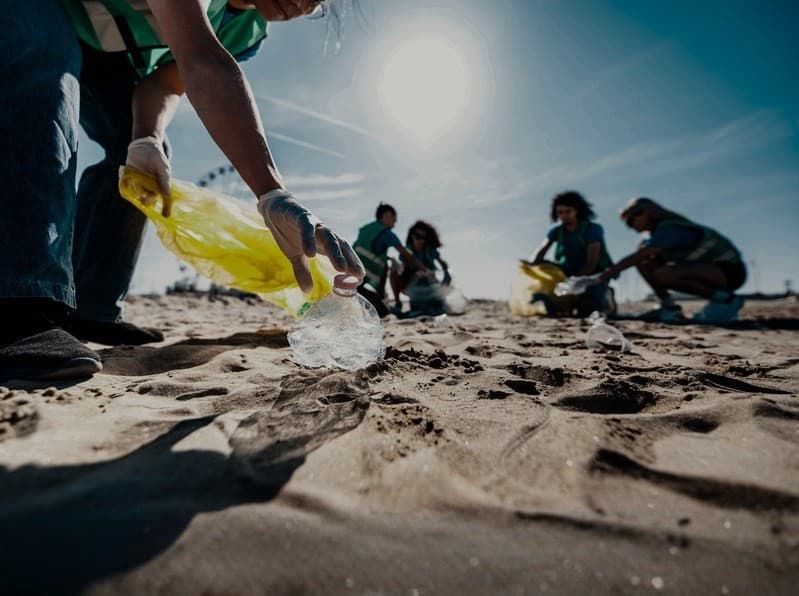
That practical framing is useful. If you are standing on a beach, five millimetres is roughly the point at which a fragment stops being a thing you can spot and grab and starts being a thing you would have to sift sand to find.
Researchers usually split the category by origin. Primary microplastics were manufactured small: the resin pellets that are the feedstock for plastic manufacturing, and the microbeads that used to be common in cosmetics. Secondary microplastics were once something bigger.
The overwhelming majority are secondary. Every bottle, bag, rope and foam cooler that weathers in sunlight is a microplastic factory, and it produces for years.
Where do microplastics come from?
Mostly from the ordinary breakdown of ordinary plastic products as they weather in sunlight and salt. Significant additional sources include synthetic textile fibres shed in the wash, tyre wear particles washed off roads by rain, fragments of paint, and the resin pellets lost during plastic manufacturing and transport.
The single largest contributor is simply the fragmentation described above: large plastic items weathering into small ones. Anything that reduces the amount of loose plastic in the environment reduces this source directly.
Synthetic clothing is a source people rarely think about. Polyester, nylon and acrylic garments shed fibres every wash, and those fibres are small enough to pass through most wastewater treatment. This is why fibres show up so consistently in water samples, including in places with no obvious plastic litter nearby.
Road runoff carries tyre wear particles, which are not conventional plastic but behave similarly as persistent synthetic microparticles. In a city with heavy rainfall and a storm drain network that discharges to a bay, this pathway is direct and fast.
Resin pellets, sometimes called nurdles, are the raw material of the plastics industry. They are shipped in bulk, and spills at ports and during transport put them straight into waterways at exactly the size that makes them uncollectable.
How do microplastics get into the food chain?
By being the right size to be eaten. Filter feeders and small fish intercept particles in the water column that fall within their normal feeding range. Larger animals then eat those animals. The particles are not sought out; they are simply present in the size class that feeding is tuned to.
The mechanism is unglamorous. An animal that feeds by straining water does not evaluate what it strains. If a fragment is in the size range it is built to capture, it captures it.
From there the particles move up through predation, though the picture is more complicated than a simple accumulating ladder. Many organisms excrete particles rather than retaining them, and the rate of retention varies enormously between species and particle types.
Microplastics also reach people directly, not only through seafood. They have been detected in drinking water, in salt, in beer, in honey, and in indoor air, which is a reminder that this is an environmental contamination question rather than strictly a marine one.
It is worth being precise here, because this topic attracts exaggeration in both directions. Detection is not the same as harm, and the presence of a particle in a sample tells you the particle is there and nothing else about what it does.
What is actually known about the health effects?
Less than the headlines suggest, and more than is comfortable. Exposure is established: particles are widely detected in human tissue and in food and water. The health consequences of that exposure at real-world levels are an active research question without a settled answer.
There are two separate questions and they get conflated constantly. The first is whether microplastics are present in people. The evidence there has moved steadily toward yes, across a growing number of tissue types and study designs.
The second is what that presence does. That question involves dose, particle size, polymer type, shape, the chemical additives carried in the plastic, and the pollutants adsorbed onto its surface from the surrounding environment. Each of those variables changes the answer, and disentangling them is slow work.
Laboratory studies at high concentrations have shown biological effects. Whether those translate to effects at environmentally realistic concentrations in humans is precisely the open question, and anyone claiming a confident answer in either direction is going beyond the evidence.
The reasonable position for a member of the public is that this is a genuine and growing area of concern, that the uncertainty is real rather than manufactured, and that the actions which reduce exposure are the same actions worth taking for other reasons anyway.
Can microplastics be removed from the ocean?
Not at scale, and not with any technology currently available. Filtering particles this small out of open seawater would mean processing an impossible volume of water and would remove plankton along with the plastic. Prevention and removing larger items before they fragment are the only workable levers.
This is the point at which the microplastic problem becomes an argument for beach cleanups rather than against them.
Once plastic is below the five millimetre threshold and dispersed through the water column, no removal method makes sense. The volume of water is too large, the particle concentration is too low, and any filter fine enough to catch the plastic catches the base of the marine food web as well.
What is possible is intervening earlier. A weathering bottle removed from a shoreline this year does not spend the next decade shedding fragments. That is not a rhetorical framing, it is the actual arithmetic of the problem: one intact item removed prevents an indefinite number of fragments.
Upstream measures matter more still. Reducing unnecessary single-use packaging, containing pellet spills at industrial sites, filtering laundry effluent, and improving storm drain interception all cut off supply rather than chasing the result.
What can one person reasonably do?
Reduce the plastic that passes through your hands, especially thin film and single-use items that fragment quickly. Wash synthetic clothing less often and on cooler cycles. Support the shoreline and street-level interception that stops items reaching water. Treat this as a supply problem, not a willpower problem.
Individual action gets dismissed as a distraction from systemic change, and that dismissal is half right. No amount of personal restraint fixes the design of a global packaging system. But the argument is often made as though the two compete, and they do not.
The most effective personal changes are the boring ones. Avoiding single-use film and foam, which fragment fastest. Choosing durable over disposable where a durable option genuinely exists. Keeping loose plastic secured so it does not blow out of a bin or a truck bed on a windy day.
For clothing, washing full loads on cooler, shorter cycles reduces fibre shedding, and a filter or wash bag reduces it further. This is a low effort change with a direct effect on a source that no cleanup can ever reach.
And there is a reason to turn up to a shoreline cleanup that has nothing to do with the weight collected. People who have spent two hours seeing what is actually in the sand tend to make different decisions afterwards, and they tend to talk about it. That shift in attention is not a measurable output, but it is not nothing either.
Frequently Asked Questions
How small is five millimetres in practice?
About the width of a pencil eraser or a grain of rice. Most of what people find on a beach is well above that threshold, which is exactly why beach cleanup works: the collectable fraction is the fraction that has not fragmented yet.
Are microbeads still in cosmetics?
Many countries restricted intentionally added microbeads in rinse-off cosmetics over the past decade, so this specific source has diminished considerably in those markets. It was never the largest source; secondary fragments from ordinary plastic products always were.
Does filtering my tap water help?
A fine filter will remove some particles, but drinking water is one exposure route among several, including food, salt and indoor air. Filtering is a reasonable personal choice and not a solution to the underlying contamination.
Is bottled water better or worse than tap?
Studies have detected microplastics in both. Bottled water introduces the additional problem that the bottle itself becomes waste, and a bottle that escapes collection becomes a microplastic source. On this specific question, the reusable option is the straightforward one.
Sources
- NOAA National Ocean Service, What are microplastics?
- NOAA, Marine Debris Program
- US Environmental Protection Agency, Trash-Free Waters
Written by
The Humanity Cares team
Humanity Cares is a Miami 501(c)(3) that runs beach cleanups and cultural activations. This is general background reading on a subject the foundation works in. It describes no specific Humanity Cares event, and every figure in it is either attributed to a named organisation or left unstated.
Keep Reading
Ocean literacy
What Happens to Plastic Once It Reaches the Ocean
A plastic bottle that washes off a Miami seawall does not disappear. Here is what the water, the sun and the salt actually do to it, and why the beach is the last cheap place to catch it.
8 min read
Waste literacy
What Actually Gets Recycled, and What Does Not
The triangle on a plastic container is a resin code, not a promise. What that number means, why some plastics have real markets and others do not, and how wishcycling makes things worse.
8 min read

Field guide
How to Run a Beach Cleanup Safely
Permissions, the safety briefing, what volunteers should never pick up, how to handle sharps and wildlife, and how to close out a cleanup properly. Written for whoever is organising, not attending.
8 min read