


Ocean literacy
What Happens to Plastic Once It Reaches the Ocean
Plastic that reaches the ocean does not break down into anything the sea can use. It breaks apart. Sunlight, salt and constant motion crack it into progressively smaller fragments that stay plastic, spread through the water column, and become effectively impossible to collect once they are small enough to drift.
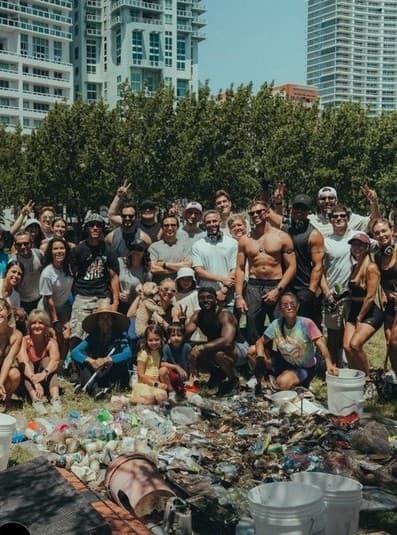
Where does ocean plastic actually go?
It goes almost everywhere. Some of it strands on the nearest shoreline within days. Some rides currents for years and accumulates in the slow rotating systems at the centre of each ocean basin. Some sinks. There is no single destination, which is why there is no single cleanup that solves it.
The intuitive picture of ocean plastic is a raft of bottles floating far offshore. That picture is mostly wrong, and the way it is wrong matters for anyone deciding where to spend a Saturday morning. Most plastic that enters the sea does not travel far. It enters near a coast, because that is where people are, and a large share of it comes back to a coast, because that is what waves do. The bottle that goes over a seawall in Miami is far more likely to end up wedged in a mangrove root or buried under six inches of sand a few miles away than it is to reach the middle of the Atlantic.
The portion that does get offshore behaves differently. Ocean currents are not random. They organise into large circulating systems, and material that drifts into the slow centre of one of those systems tends to stay there, turning, for a very long time. Those accumulation zones are real, but they are not solid islands. They are dilute, wide, and mostly made of pieces too small to photograph well.
The rest sinks, either because it was denser than seawater to begin with or because it picked up enough biological growth on the way to lose its buoyancy. Once a fragment is on the seafloor it is out of reach of every practical removal method that exists.
Why does plastic float, sink, or do both?
Buoyancy depends on the polymer and on what grows on it. Polyethylene and polypropylene, the plastics in most bags, bottle caps and packaging, are less dense than seawater and float. PET bottles, vinyl and most synthetic rope sink. Biofouling changes the answer over time for all of them.
Every piece of marine debris has a density, and seawater has a density, and the relationship between the two decides where in the water column the piece spends its life. That is the whole mechanism, and it explains a lot of otherwise confusing observations.
Bags, film, foam and bottle caps sit at or near the surface. This is why surface photography of ocean plastic is dominated by exactly those items, and why they are also the items that wash up on a beach in quantity. They are the visible fraction, and the visible fraction is the collectable fraction.
Denser items, including many drink bottles once the cap is off and the bottle fills, spend their lives below the surface or on the bottom, and are undercounted in almost every survey done from a boat. Biofouling complicates all of it: a clean floating fragment gradually acquires algae and barnacles, that growth adds weight, and a piece that floated for a season can sink.
What does sunlight do to plastic at sea?
Ultraviolet light attacks the long molecular chains that give plastic its strength. The material becomes brittle rather than soft, and then wave action and abrasion against sand snap it into smaller and smaller fragments. This is photodegradation, and it is fragmentation, not decomposition.
There is a common assumption that plastic left in the sun eventually rots away the way driftwood does. It does not. Wood is broken down by organisms that can digest it into carbon dioxide, water and biomass. Effectively nothing in the ocean can digest polyethylene at any meaningful rate.
What sunlight does instead is snap the polymer chains. A bottle that has spent a year on an exposed shoreline looks chalky and faded, and if you flex it, it cracks rather than bends. Then the ocean does the mechanical work: waves lift the brittle fragment, sand grinds it, and the piece splits. Each of those pieces is exposed to the same treatment.
The critical detail is that the total mass of plastic does not meaningfully decrease during this. It only gets divided into more, smaller, harder to find units. A shoreline that looks clean from standing height can hold an enormous number of fragments in the top layer of sand.
How does plastic harm marine life?
Through two distinct routes. Entanglement, where an animal is caught in netting, line or packaging and cannot free itself, and ingestion, where an animal eats plastic because it resembles food. Both are documented across a wide range of species, from seabirds and sea turtles to fish and invertebrates.
Entanglement is the more visible harm and the easier one to explain. Derelict fishing gear, monofilament line, strapping bands and the rings from multipacks all form loops. A loop that fits over a head, a flipper or a fin does not come off, and as the animal grows the loop tightens.
This is the reason that fishing line found during a cleanup is worth handling as a priority item rather than as one more piece of litter. It is unusually persistent, unusually strong, and unusually likely to catch something.
Ingestion is less visible and more widespread. A drifting clear bag has roughly the profile of a jellyfish. A small fragment of coloured film in the water column has roughly the profile of the food particles a filter feeder is built to intercept. Animals are not making a mistake so much as encountering something their sensory equipment was never built to distinguish.
The consequences depend on what was eaten and by what. Plastic in a digestive tract does not provide calories and can take up space that food would otherwise occupy. Beyond the physical effects, plastics carry chemical additives and can adsorb other pollutants from seawater, which introduces a second, slower question that researchers are still working through.
Does plastic ever biodegrade in seawater?
Conventional plastics do not biodegrade in the ocean on any timescale relevant to a human life. Products labelled compostable are typically certified for industrial composting, which involves sustained high temperatures that seawater cannot supply. In the ocean, most of them behave like ordinary plastic.
Biodegradable means that organisms can break the material down, but the label rarely states under what conditions or over what period. Compostable is a stricter and more useful claim, but the certification behind it almost always refers to an industrial composting facility: a controlled environment with high temperatures, managed moisture and a specific microbial community.
The open ocean is cold, dark below the surface, and lacks that microbial community. A cup certified compostable in a facility can persist in seawater more or less indefinitely.
Why is the beach the cheapest place to catch it?
Because a shoreline concentrates debris where people can reach it, on foot, with no vessel and no equipment. A fragment on the sand can be picked up by hand in a second. The same fragment offshore, or broken down further, cannot practically be recovered at any cost.
There is a straightforward economic logic to shoreline cleanup that has nothing to do with how it feels. Cost per item removed rises steeply the further a piece of plastic travels from land, and it rises again every time the piece breaks in half.
Removing an intact item also prevents every fragment it would have become. Pulling one embrittled bottle off a beach today is not equivalent to removing one piece of litter; it is removing the several thousand fragments that bottle was going to produce over the following years.
That is the honest case for a beach cleanup. It is not that it solves ocean plastic, because it does not. It is that a shoreline is the last point in the whole system where an ordinary person with a bucket can still intervene at all.
Frequently Asked Questions
Is there really an island of trash in the Pacific?
Not an island. The accumulation zones are real but they are dilute and enormous, made largely of small fragments spread through the surface water rather than a solid mass you could stand on. Photographs suggesting otherwise are usually taken close to a harbour or a river mouth after a storm.
Does picking up litter on a beach do anything measurable?
It removes that material permanently, and it removes every fragment that material would have shed. It does not address the flow of new plastic into the water, which is a policy and design problem. Both things are true at once, and treating cleanup as either a solution or a waste of time gets it wrong in different directions.
Which items are worth prioritising during a cleanup?
Fishing line and netting, because of entanglement risk and their strength. Foam, because it fragments faster than almost anything else. Anything already brittle and cracking, because it is about to become uncollectable. Cigarette filters, because they are numerous and small enough to be missed.
Do plastics eventually disappear completely?
Not in any practical sense. They fragment until the pieces are microscopic and then continue as microplastics and nanoplastics. The mass persists. This is why prevention and removal while items are still intact both matter more than they intuitively seem to.
Sources
- NOAA National Ocean Service, What is marine debris?
- NOAA, Marine Debris Program
- US Environmental Protection Agency, Trash-Free Waters
- Ocean Conservancy, International Coastal Cleanup
Written by
The Humanity Cares team
Humanity Cares is a Miami 501(c)(3) that runs beach cleanups and cultural activations. This is general background reading on a subject the foundation works in. It describes no specific Humanity Cares event, and every figure in it is either attributed to a named organisation or left unstated.
Keep Reading
Ocean literacy
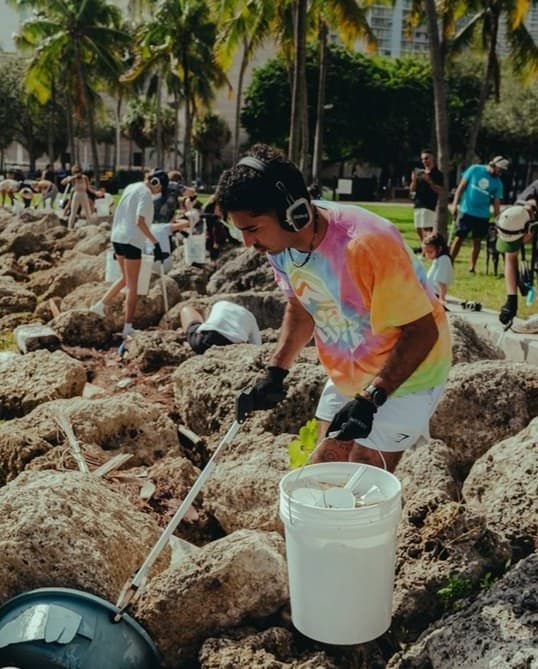
Where Beach Litter Actually Comes From
Most of what strands on an urban shoreline never came off a boat. It came off a street. How stormwater, wind and tides move litter from inland to the waterline, and what that means for where you clean.
8 min read
Local ecology
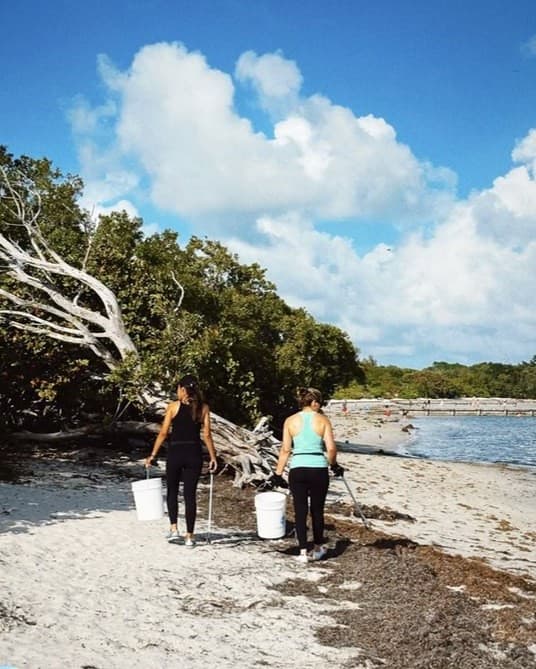
Why Biscayne Bay's Mangroves Matter
Mangroves hold the shoreline together, shelter juvenile fish and buffer storm surge. They also catch an extraordinary amount of plastic, which makes them delicate places to clean.
8 min read
Local ecology
How Hurricane Season Moves Debris Onto Miami's Shoreline
A storm does not create litter, it relocates it. How surge, wind and rain move land-based waste into Biscayne Bay and onto beaches, and what volunteers should and should not do afterwards.
8 min read