


Local ecology
Why Biscayne Bay's Mangroves Matter
A mangrove is a tree that grows in salt water, holds a coastline in place with its roots, and shelters the juvenile stage of a large share of the fish that adults later catch offshore. Along Biscayne Bay it also does something nobody designed it for: it catches plastic and holds onto it.
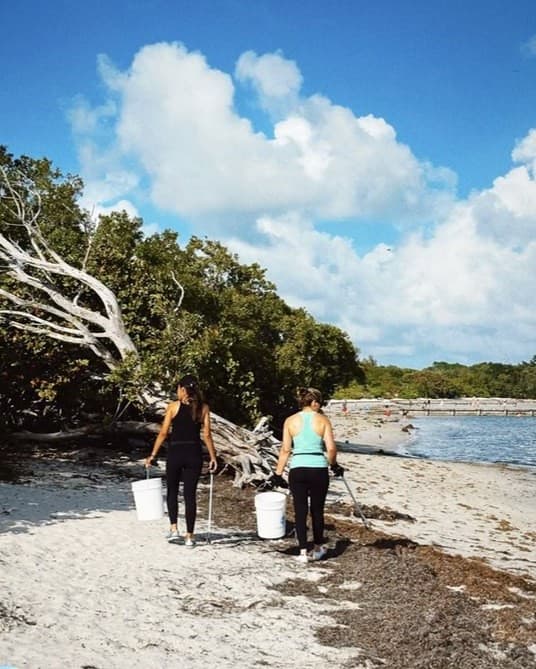
What is a mangrove forest?
A mangrove forest is a coastal woodland of salt-tolerant trees growing in the intertidal zone, the band of shoreline that floods and drains with the tide. NOAA's National Ocean Service describes these forests as occurring in tropical and subtropical latitudes, on sheltered coasts where fine sediment can settle.
Most trees die in salt water. Mangroves have evolved several distinct solutions to the problem: excluding salt at the roots, excreting it through the leaves, or concentrating it in older leaves that are then shed.
The second problem they solve is oxygen. Waterlogged coastal mud has very little of it, which is why the aerial root structures are so distinctive. Red mangroves stand on arching prop roots that lift the trunk clear of the water. Black mangroves send up thin vertical shoots from the mud around the trunk, which is how the tree gets air to roots sitting in sediment that has almost none.
Those roots are the reason mangroves matter structurally. They form a dense, three-dimensional mesh at exactly the height where water meets land. It traps sediment, dissipates wave energy, and physically holds a shoreline together.
In South Florida the three species usually described are red, black and white mangroves, generally arranged in bands according to how much time each tolerates standing in salt water, with red mangroves furthest out.
What do mangroves do for fish?
They work as a nursery. The submerged root tangle is a physical refuge where juvenile fish and invertebrates are protected from larger predators while they grow. Many of the species later caught in open water spend their earliest months inside mangrove roots.
The nursery function is the mangrove service that connects most directly to people's lives, and it is the easiest to overlook because it happens out of sight underwater.
The mechanism is simple geometry. A dense mesh of prop roots creates spaces large enough for a small fish and too small for the thing that would eat it. Add shade, structure for algae and invertebrates to grow on, and a steady fall of organic material from the canopy, and you have somewhere juveniles can feed while staying alive.
The result is that a mangrove fringe supports populations far beyond its own footprint. Species harvested commercially and recreationally miles offshore may have depended on a few hundred metres of root structure at the start of their lives.
This is also why mangrove loss shows up as a fisheries problem years later rather than immediately. The trees go, and the effect appears when the cohort that would have sheltered there fails to arrive.
How do mangroves protect against storms?
By absorbing energy rather than reflecting it. A band of mangroves reduces wave height as water passes through the root structure, slows surge, and anchors sediment that would otherwise wash away. For a low-lying coastal city that is flood infrastructure which maintains itself.
Wave energy dissipates when water has to force its way through obstruction. A wide belt of prop roots is an extremely effective obstruction, and it works passively, continuously, and without a maintenance budget.
The sediment effect compounds. Trapped sediment builds substrate, the substrate supports more trees, and the belt widens. A healthy mangrove fringe is one of the few coastal defences that gets stronger on its own over time.
Compare that to a seawall, which is a fixed structure that reflects wave energy instead of absorbing it, begins degrading the day it is installed, and requires capital to maintain and eventually to replace.
For a city built barely above sea level on a bay, this is not an abstract ecological benefit. It is part of the difference between a shoreline that recovers from a storm and one that has to be rebuilt.
Mangroves also store substantial carbon in their sediments, which is why coastal wetland protection has become a live topic in climate policy as well as in coastal engineering.
Why does so much plastic end up in the roots?
Because a mangrove root system works like a filter that never empties. The same structure that traps sediment traps floating debris. A rising tide pushes material into the tangle, a falling tide strands it above the waterline, and ordinary tides rarely take it back out.
Mangroves are, functionally, a filter at the edge of the bay, and in an urban bay a significant fraction of what the water carries is plastic. This produces a striking and depressing sight: a stretch of shoreline that is ecologically valuable and visibly packed with bottles, foam, bags and fragments lodged in the roots at high-water height.
It also means mangroves accumulate rather than pass material through. A sand beach is scoured and redeposited constantly. A mangrove fringe holds what it catches, and debris can sit in the same root system for years, weathering and fragmenting in place.
The debris is usually behind the first row of trees, which is exactly where nobody looks from the water and where nothing washes it away. A fringe can look untouched from a boat and be full of plastic once you are inside it.
That combination, high ecological value plus high debris accumulation, is what makes mangrove shorelines both a priority for removal and a difficult place to work.
How do you clean a mangrove without damaging it?
Carefully, in small groups, on a falling or low tide, and only with the land manager's agreement. Prop roots break under body weight and do not grow back. Reach in and remove debris rather than pushing through, and leave anything that will not come free with a firm pull.
The roots are structural and brittle. Standing on them, leaning on them or forcing a path through breaks them, and a broken prop root is a permanent loss for that tree. A large, enthusiastic group can do more damage than the plastic it removes.
Access is the second constraint. Mangrove mud is deep and uneven and hides sharp debris, and much of the workable material is reached from a kayak or paddleboard, or from an adjoining seawall or trail, rather than by wading in.
Timing helps. A low or falling tide exposes the debris band and shortens the reach required. It also reduces the temptation to move through water that conceals what is underfoot.
Entangled line is a special case. Cutting it free is almost always better than pulling, because pulling transfers the load to the root the line is wrapped around.
In protected areas this activity may require specific authorisation, and mangroves are regulated under Florida law in ways that restrict trimming and disturbance. Ask the managing agency before planning anything beyond removing loose debris by hand.
What threatens mangroves in South Florida?
Coastal development and the hardening of shorelines with seawalls, altered freshwater flow, declining water quality in the bay, and sea level rise where landward migration is blocked by what has been built behind them. Debris is a visible stress layered on top of those structural pressures.
The dominant historical threat is straightforward: mangroves grow exactly where waterfront property is most valuable, and a great deal of South Florida's original fringe was cleared, filled and replaced with seawalls.
Water quality is a continuing pressure on the wider bay system. Nutrient loading from runoff and from wastewater infrastructure drives algal blooms and seagrass loss, and a degraded bay is a poorer place for everything that depends on it.
Sea level rise interacts badly with development in a way that is not intuitive. Mangroves can in principle keep pace with rising water by migrating landward. Where there is a seawall, a road or a building immediately behind them, there is nowhere to migrate to, and the belt is squeezed between rising water and hard infrastructure.
Against that, the protections in Florida law and the presence of large protected areas around the bay mean the remaining mangroves have real legal standing. Removing plastic from them is a small, hands-on contribution to a system whose larger problems are decided in planning offices.
Frequently Asked Questions
Can I trim mangroves on my own property?
Mangroves are regulated in Florida and trimming or removal is restricted, with the specifics depending on the height of the trees and the details of the site. This is a question for the Florida Department of Environmental Protection or the delegated local authority before any cutting happens.
Is it safe to wade into mangroves to collect litter?
Often not. The mud is deep and uneven, it conceals broken glass and metal, and the root structure is a trip hazard that breaks under weight. Most mangrove cleanup is done from the water in a kayak or from an adjoining edge, and only with the land manager's agreement.
Can I just pull debris out of the roots?
Loose material by hand, yes. Anything wedged, buried or wrapped around a root needs judgement, because freeing it may mean breaking the root, and the damage can outweigh the benefit. Cutting entangled line is usually better than pulling it.
Where can I see mangroves around Biscayne Bay?
Biscayne National Park protects a substantial mangrove shoreline along the bay, and there are fringes in a number of county and state parks around its edge. Check the managing agency's site for current access and any closures before visiting.
Sources
- NOAA National Ocean Service, What is a mangrove forest?
- National Park Service, Biscayne National Park
- Florida Department of Environmental Protection, Water Resource Management
- FWC, Florida Fish and Wildlife Conservation Commission
Written by
The Humanity Cares team
Humanity Cares is a Miami 501(c)(3) that runs beach cleanups and cultural activations. This is general background reading on a subject the foundation works in. It describes no specific Humanity Cares event, and every figure in it is either attributed to a named organisation or left unstated.
Keep Reading
Local ecology
Sargassum on South Florida Beaches, and What Volunteers Should Do About It
The brown seaweed that piles up on South Florida beaches is habitat, not rubbish. Why it arrives, why it smells, what it traps, and the one job volunteers should actually be doing when it is there.
8 min read

Local ecology
How Hurricane Season Moves Debris Onto Miami's Shoreline
A storm does not create litter, it relocates it. How surge, wind and rain move land-based waste into Biscayne Bay and onto beaches, and what volunteers should and should not do afterwards.
8 min read
Ocean literacy
What Happens to Plastic Once It Reaches the Ocean
A plastic bottle that washes off a Miami seawall does not disappear. Here is what the water, the sun and the salt actually do to it, and why the beach is the last cheap place to catch it.
8 min read