


Ocean literacy
Where Beach Litter Actually Comes From
The great majority of litter on an urban beach is land-based. It was dropped or blew off a street, entered a storm drain during rain, travelled through a culvert to a canal or bay, and was delivered to the shoreline by tide and wind. Understanding that route explains almost everything about where debris concentrates.
Is beach litter mostly from boats?
No. On most urban and near-urban shorelines the dominant source is land-based: everyday consumer litter carried to the water by stormwater and wind. Sea-based sources matter, particularly derelict fishing gear, but they are a minority of the item count on a typical city beach.
The assumption that marine debris comes from ships is intuitive and mostly wrong for the beaches nearest to where people live. The composition of what gets collected gives it away.
The items that turn up in the greatest numbers on an urban shoreline are the items of ordinary daily life: food wrappers, beverage containers and their caps, straws and stirrers, cigarette filters, plastic bags and cups, and takeaway containers. None of that comes from a boat.
Sea-based debris exists and it is disproportionately damaging. Derelict nets, traps and monofilament line keep catching animals long after they stop being useful, which is why they are worth prioritising during a cleanup even though they are outnumbered.
The practical implication is that a shoreline cleanup is largely dealing with a city's litter problem at the point where it finally becomes visible.
How does a storm drain move litter to the sea?
In most coastal cities, stormwater is a separate system from sewage and receives no treatment. Rain washes street litter into the drain, the drain discharges to a canal, river or bay, and whatever floats travels outward. It is a direct pipe from pavement to water.
This is the single most important piece of infrastructure knowledge for understanding urban marine debris, and it surprises most people.
Sanitary sewage goes to a treatment plant. Stormwater usually does not. It is designed to move rainfall off streets as fast as possible to prevent flooding, and speed is the design priority, not filtration. Anything light enough to float goes with it.
That is why the first heavy rain after a dry spell produces a visible pulse of debris in canals and along shorelines. Weeks of accumulated street litter is flushed in a few hours.
It also explains why a beach can be cleaned thoroughly one weekend and look untouched two weeks later. The cleanup addressed the material that had already arrived. It did not touch the supply.
Some cities fit screens, booms or interception devices at outfalls. Where those exist they are one of the highest-leverage interventions available, because they catch material before it disperses.
Why does litter collect along the wrack line?
The wrack line is the band of seaweed and natural debris marking the reach of the last high tide. Floating material is deposited there by the same physics that deposits seaweed. It is the highest-density strip on any beach, and it is where an experienced volunteer works.
Beaches are not uniformly littered, and treating them as though they are wastes most of a cleanup's time.
As a tide rises it carries floating material shoreward. At the top of the tide the water stops, drops what it is carrying, and retreats. What is left is a line of seaweed, shells, driftwood and, on an urban beach, plastic.
There may be several such lines visible at once, from successive tides and from storm events that pushed further inland. Each is worth walking. The one furthest up the beach is often the oldest and holds the most weathered, brittle material.
The important discipline is to remove the litter and leave the rest. The seaweed and natural debris in a wrack line is habitat and a food source for shorebirds and invertebrates, and stripping it out to make the beach look tidy causes ecological harm for a cosmetic gain.
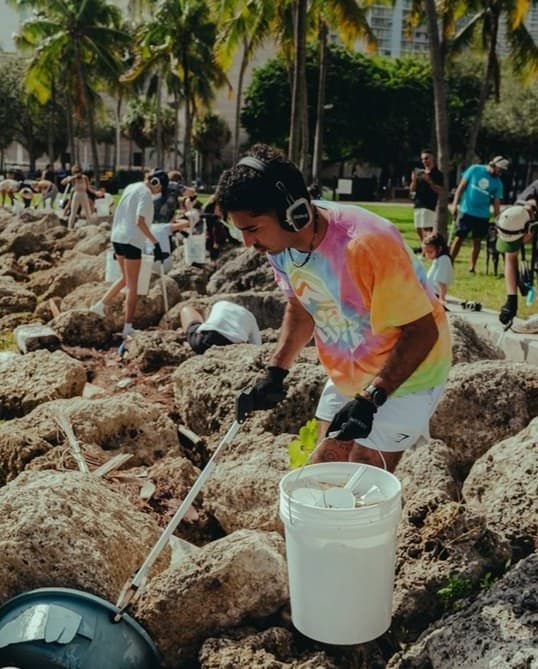
The other high-density zones are wherever water slows down or is blocked: against seawalls and rock revetments, at the base of piers and jetties, in the corners of coves, and in vegetation at the back of the beach.
What role does wind play?
A large one, particularly for lightweight items. Film plastic, foam, bags and cups can travel considerable distances by wind alone, escaping open bins, uncovered truck beds and landfill faces. Wind also determines which side of a bay collects debris on any given week.
Wind is the transport mechanism people account for least, partly because it does not leave a visible trail.
An open public bin on a windy day is a distribution system. So is an uncovered load in a truck, an overfilled dumpster, and the working face of a landfill. Foam is the worst offender because its mass-to-surface-area ratio is so low that almost any breeze moves it.
On the water, wind pushes floating debris across a bay and stacks it against whichever shoreline is downwind. This is why the same beach can be heavily littered one week and comparatively clean the next with no change in the total amount of debris in the system.
For an organiser, this is a useful planning input. A shoreline that has been downwind for several days will be more productive than one that has been in the lee, and a cleanup immediately after a sustained onshore wind tends to find substantially more.
Which items show up most often?
The same categories turn up consistently across international cleanup datasets: cigarette filters, food wrappers, beverage bottles and their caps, straws and stirrers, cups, cutlery, carrier bags, and foam containers. Almost all of it is single-use packaging designed to be discarded within minutes of the purchase it came with.
Ocean Conservancy's International Coastal Cleanup has coordinated volunteer data collection for decades, and the broad picture from that work has been stable: the top of the list is dominated by single-use food and drink packaging.
Cigarette filters deserve their own note because they are consistently among the most numerous items and are widely assumed to be biodegradable. Most are made of cellulose acetate, a plastic, and they fragment like one.
Bottle caps are similarly over-represented relative to bottles. They float when the bottle sinks, they are small enough to be swallowed by seabirds and turtles, and they are easy to miss on textured sand.
Recording what is found, in categories rather than only by weight, is what makes this pattern legible. Weight tells you how much a group lifted; item counts tell you what a city is losing to its own drains.
What stops litter before it reaches the beach?
Interception at storm drain outfalls, covered public bins that are emptied often enough not to overflow, secured waste transport, and less single-use packaging in the first place. Each of those intervenes earlier in the chain than a cleanup does, and earlier is always cheaper per item recovered.
Everything in this article points toward the same conclusion: the shoreline is the end of the pipe, not the source.
Interception devices at outfalls, from simple screens to booms and floating traps, catch material at a chokepoint before it disperses into open water. They require maintenance and someone to empty them, which is usually the real constraint rather than the hardware.
Street-level measures are unglamorous and effective. Bins that are covered, numerous enough, and emptied before they overflow prevent an enormous amount of material from ever entering a drain. So does securing loads in transport.
Upstream of that is packaging design and volume, which is a policy question rather than an operational one, and the one with the largest ceiling.
None of this makes cleanups redundant. A cleanup is the only intervention available to an ordinary person on a Saturday, it removes material that would otherwise fragment permanently, and it puts people face to face with the composition of the problem in a way no statistic does.
Frequently Asked Questions
Why does a beach look littered again so soon after a cleanup?
Because a cleanup removes what has arrived, not the supply. Tides and wind deliver a fresh load continuously, and heavy rain flushes weeks of accumulated street litter through storm drains in a few hours. Repetition is not futility; it is what dealing with a flow rather than a stock looks like.
Is it better to clean the beach or the street?
The street intervenes earlier and is therefore cheaper per item prevented. The beach catches what the street missed and removes material that is close to fragmenting beyond recovery. They are complementary, and the beach has the advantage of being where people will actually turn up.
Where on a beach should a group start?
The wrack line first, then structural edges: seawalls, rock revetments, the base of piers, and the vegetation line at the back of the beach. Open, well-trafficked dry sand in the middle is usually the least productive ground.
Does recording what is found matter?
Yes, and item categories matter more than total weight. Weight is dominated by whatever heavy object happened to be found. Counts by category are what reveal which products keep arriving, which is the information that can change something upstream.
Sources
- Ocean Conservancy, International Coastal Cleanup
- US Environmental Protection Agency, Trash-Free Waters
- NOAA National Ocean Service, What is marine debris?
- Miami-Dade County, Solid Waste Management
Written by
The Humanity Cares team
Humanity Cares is a Miami 501(c)(3) that runs beach cleanups and cultural activations. This is general background reading on a subject the foundation works in. It describes no specific Humanity Cares event, and every figure in it is either attributed to a named organisation or left unstated.
Keep Reading

Field guide
How to Run a Beach Cleanup Safely
Permissions, the safety briefing, what volunteers should never pick up, how to handle sharps and wildlife, and how to close out a cleanup properly. Written for whoever is organising, not attending.
8 min read
Field guide
What to Bring to a Beach Cleanup
The short list of things that make a two-hour cleanup comfortable and safe, the gear that sounds useful and is not, and what organisers should supply rather than expect volunteers to bring.
7 min read

Ocean literacy
What Happens to Plastic Once It Reaches the Ocean
A plastic bottle that washes off a Miami seawall does not disappear. Here is what the water, the sun and the salt actually do to it, and why the beach is the last cheap place to catch it.
8 min read